
Destoner Machine Manufacturer in India
Thermocare Industries Limited provides industrial Destoner and stone-separator solutions for suitable product streams where stones or other high-density impurities need to be separated. Thermocare's demonstrations cover whole and cut supari; company-published application information also lists grains, rice, wheat, pulses, seeds, spices and nuts. Suitability and separation results must be evaluated for the actual material, contamination and operating conditions.
See the Destoner in operation: 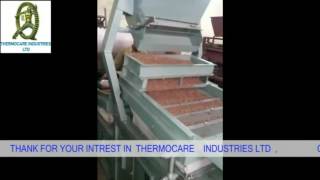 .
.
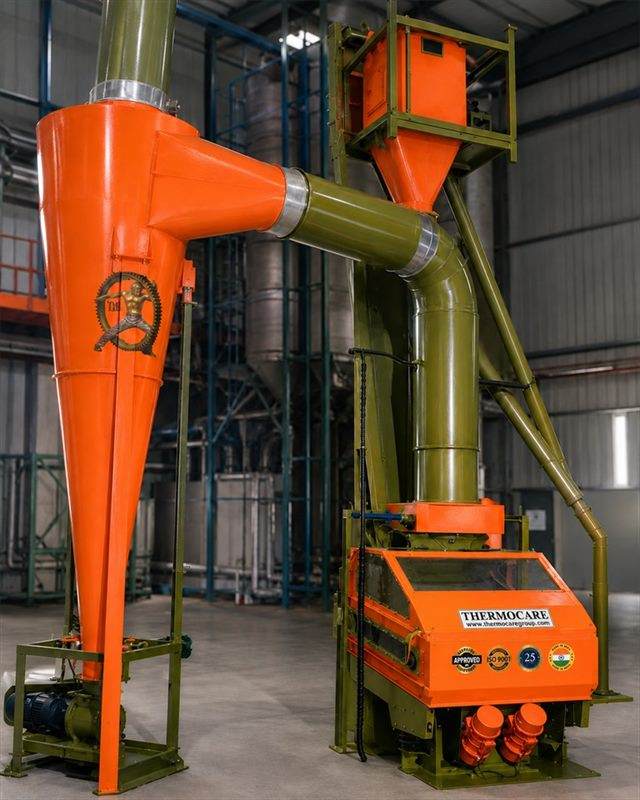
What a Destoner is used for
A Destoner is used for density-based separation when the wanted product and heavier foreign material respond differently under the selected operating conditions. Thermocare's cut-supari demonstration describes separation of stones, glass, peel and iron particles from raw supari. That demonstration is not a guarantee for every product or contamination profile: particle size and shape, density, moisture, feed condition and machine setup all affect the result. Some objectives may also require screening, magnetic separation, visual inspection or another process step.
How a Destoner works
Material is fed into a separation zone at a controlled rate. In an air-assisted gravity-destoning arrangement, airflow and controlled material movement help form a layer in which product and denser impurities behave differently. The streams are guided toward separate product and reject outlets. The exact deck, airflow path, movement, adjustments and operating sequence depend on the selected model. A sample review or trial can help assess whether the intended separation is achievable for a particular material.
Main components and their functions
- Feed hopper or feeder: introduces material to the separation zone; feed rate and distribution should suit the process.
- Separation deck or table: supports material movement and, where the selected design uses it, works with controlled airflow to support separation.
- Air-handling arrangement: supplies or manages airflow in an air-assisted configuration; its design and adjustment range are project-specific.
- Drive and movement mechanism: creates the selected material motion where required by the model; exact drive details are confirmed in the technical offer.
- Product and reject outlets: direct the separated streams for collection or onward processing.
- Support frame, controls and access points: support the selected equipment arrangement and allow operation and inspection; included controls and safety provisions must be confirmed for the model.
Construction and configuration
Destoner construction is selected for the material and process rather than assumed to be identical for every application. Contact-part and structural materials, deck or screen details, drive, airflow equipment, controls, dimensions and discharge arrangements must be confirmed in the project quotation and approved drawing. Relevant selection inputs include product and contaminant properties, moisture, required feed rate, cleaning needs, installation space, utilities and connection to upstream or downstream equipment. This page is application guidance, not a machine specification or performance guarantee.
Material and process evaluation
For a responsible recommendation, share the product and foreign-material names, approximate size and condition, moisture or stickiness, expected contamination, desired separation result, feed rate, operating schedule, sample availability, available footprint and electrical or air-handling conditions. A material trial may be appropriate when recovery, cleanliness or product loss needs to be assessed before finalising a configuration.
Integration with a processing line
A Destoner may be reviewed as part of a broader material-handling or cleaning sequence. Depending on the process, the discussion can include upstream feeding, screening, aspiration, dust collection and downstream handling. Related solutions can be explored through Vibro Sifter and Dust Collector.
Operation and maintenance considerations
Consistent feeding and correct adjustment are important to a stable separation result. Inspect the separation area, product paths and any air-handling components included in the selected system according to the supplied operating instructions. Isolate the machine as required by the site safety procedure before clearing, cleaning or maintenance. Cleaning method and frequency depend on the processed material and the equipment configuration.
India-wide and export enquiries
Thermocare is based in Kanpur, Uttar Pradesh and welcomes Destoner enquiries from buyers across India, including industrial centres such as Delhi, Mumbai, Pune, Ahmedabad, Bengaluru, Hyderabad, Chennai, Kolkata, Jaipur and Lucknow. Thermocare also reviews export enquiries from markets including the UAE (Dubai), Nepal, Sri Lanka and the USA. Technical scope, logistics and destination requirements are confirmed for each project; no local branch is implied by these enquiry locations.
Frequently asked questions
Which materials can a Destoner handle?
Thermocare has demonstrated Destoner applications for whole and cut supari. Company-published application information also lists grains, rice, wheat, pulses, seeds, spices and nuts. Suitability for a particular product and lot should be checked against its physical properties and the required separation result.
How does a Destoner separate stones from product?
Destoning relies on differences in density and material behaviour under the selected airflow and movement conditions. The correct arrangement and settings depend on the product, contaminants, feed and desired outcome.
Can a Destoner remove every type of foreign material?
No. Thermocare's cut-supari demonstration describes separation of stones, glass, peel and iron particles from raw supari, but results for other products or contamination profiles must be evaluated. Different particle properties may require screening, magnetic separation, inspection or another process.
What are the main components of a Destoner?
Depending on the selected design, a system may include a feed arrangement, separation deck or table, air-handling components, a drive mechanism, product and reject outlets, a support frame and controls. The exact build is confirmed for the project.
What construction materials and configuration will be supplied?
Materials, deck details, drive, airflow and controls are selected for the specific application. Exact specifications should be taken from the approved technical quotation and drawing rather than assumed from a general web description.
What details are needed for selection?
Share the material, expected foreign matter, approximate particle size, feed condition, moisture, target result and feed rate, available space, site utilities and any relevant safety or cleaning requirements.
Can you evaluate a sample or separation issue?
Yes. A sample review or trial may be appropriate where the material behaviour and target separation need confirmation.
Can I enquire about a Destoner for a plant in Delhi, Mumbai or another Indian city?
Yes. Thermocare is based in Kanpur, Uttar Pradesh and welcomes Destoner enquiries from across India, including Delhi, Mumbai, Pune and other industrial centres. These are enquiry destinations, not claims of local branches. Export enquiries are reviewed individually, with technical scope, logistics and destination requirements confirmed for each project.
How do I start an enquiry?
Start through the Contact page. WhatsApp: +91 79916 56592 or +91 96705 15151. Call: +91 79916 56592 or +91 96705 15151. Please include the material and separation requirement.