
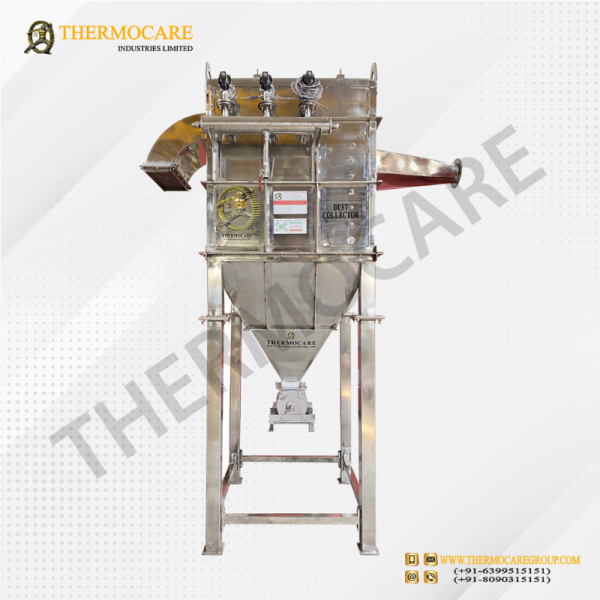
Pulse-Jet Dust Collector Systems for Industrial Processes
Thermocare Industries Limited manufactures pulse-jet dust collectors for industrial powder and material-handling processes. Each enquiry is reviewed around the dust or material, required airflow, pickup points, operating conditions, available space and the required collection or discharge arrangement.
What is an industrial dust collector?
An industrial dust collector removes airborne particulate generated during manufacturing, material transfer, grinding, mixing, conveying, sifting, filling or packaging. A correctly selected system captures dust near the source, transports it through ducting, separates it from the air stream and collects or discharges the separated material.
Selection cannot be based on machine size or motor power alone. The hood, duct route, airflow, static pressure, filter area, cleaning arrangement, blower and dust discharge must work as one system. The actual dust and process conditions must be reviewed before a configuration is finalised.
Discuss your application: Request technical selection | WhatsApp +91 70078 69305 | WhatsApp +91 63995 15151
Before requesting a quotation
Share the dust or material, process, number of pickup points, plant photographs or layout, available space and installation city. An engineer should review the actual project information before final selection.
Send your Dust Collector requirement
View Thermocare machinery and installation videos on YouTube
How does a pulse-jet dust collector work?
- Dust is generated at a process, feed, discharge or transfer point.
- A hood or enclosure captures the dust as close to its source as practical.
- A blower creates the airflow needed to move the dust-laden air.
- Ducting carries the air stream to the collector inlet.
- Filter media retains particulate while the air passes through the media.
- Dust accumulates on the filter surface during operation.
- Short pulses of compressed air clean the filters.
- The dislodged dust falls into the hopper.
- Material is collected, recovered or discharged through the selected arrangement.
- Filtered air leaves through the outlet. Indoor recirculation should be considered only after the dust, filtration result, process risk and applicable requirements are reviewed.
Main components of a dust collection system
- Capture hood or enclosure: captures dust near the point where it is generated.
- Ducting and collector inlet: carry and introduce the dust-laden air.
- Filter housing and filter elements: contain the filtration and cleaning zones.
- Cages, venturi, pulse pipes, header and valves: support or clean the filters where included.
- Pulse controller: controls the cleaning sequence.
- Differential-pressure instrument: helps monitor filter resistance when supplied.
- Hopper and discharge assembly: receive and transfer collected material.
- Centrifugal blower and motor: generate the required airflow and pressure.
- Control panel, access doors and support structure: provide project-specific operation, access and support.
The supplied components depend on the approved project scope; every collector does not include every item listed above.
Dust capture points, industries and process applications
Dust capture may be evaluated at bag-dumping stations, hopper feeding points, pulverizer or grinder outlets, mixer charging and discharge points, sifters and separators, bucket elevators, conveyor transfers, pneumatic conveying receivers, silo vents, weighing stations, filling lines and packaging operations.
First-release industry focus
- Powder and food-processing lines.
- Flour and atta handling.
- Spice and masala grinding or transfer.
- Grain, rice and pulse handling.
- Kattha and pan-masala processing.
- Mixing, pulverizing, sifting, conveying and packaging operations.
The actual dust, hygiene requirements, construction, filter media, product-recovery arrangement and safety risks must be reviewed for each application. The list describes common engineering locations and does not mean that one collector configuration is suitable for every process.
Current documented Kattha application
The existing Thermocare application shows Kattha dust retained on the filter surface, compressed-air pulses cleaning the filters and the separated material falling into the hopper. Pickup points, airflow, filter media, discharge arrangement and site conditions must be confirmed for each new project.
Related process equipment: Pulverizer, Paddle Mixer, Vibro Sifter and Screening/Separator.
Information required for Dust Collector selection
For technical evaluation, share as much of the following information as is available:
- Dust or material name and an SDS/MSDS where available.
- Process generating the dust and number and location of pickup points.
- Existing hood, duct dimensions or required airflow if already calculated.
- Particle size, dust loading, bulk density, moisture and stickiness if known.
- Abrasiveness, corrosiveness, inlet temperature and ambient conditions.
- Batch or continuous operation and expected operating hours.
- Whether separated material should be recovered or discarded.
- Required hopper-discharge method.
- Available compressed air and electrical supply.
- Indoor or outdoor installation, floor area and clear height.
- Required construction or contact-part material.
- Combustible, toxic or other hazard information.
- Plant layout, photographs, drawings, installation city and timeline.
Thermocare does not issue a final selection from an automated website calculation. An engineer must review the actual project information.
Filter media, construction and dust discharge
What affects filter-media selection?
Filter media should be selected from the actual dust and operating conditions. Important factors include particle characteristics, temperature, moisture, chemistry, cleaning method, required filtration area, operating pressure drop, discharge arrangement and the required outlet condition. One filter material should not be presented as universally suitable. A stated micron efficiency or outlet concentration requires the exact media, design basis and test evidence.
Construction and material options
The required construction depends on the handled material, corrosion risk, hygiene needs, temperature, cleaning method, installation environment and commercial scope. The quotation should identify the collector housing, contact parts, frame, hopper, ducting, finish and any project-specific material certificates. A stainless-steel grade should not be assumed unless it is stated in the approved quotation.
Dust discharge and product recovery
Collected material must be removed without creating an uncontrolled dust release. Depending on the project, discharge may be into a bag, drum, bin or downstream mechanical device. Product recovery, disposal, continuous discharge, process pressure and leakage control affect the arrangement.
Ducting, hoods and pickup-point design
A collector can perform properly only when dust is captured and conveyed effectively. Hood position, enclosure, duct diameter, duct length, bends, branches, air velocity, pressure loss and simultaneous pickup points influence the required blower duty and collector selection. A larger blower does not correct a poorly positioned hood or unsuitable duct system; excess airflow can disturb the process or carry unwanted product.
Controls, installation, maintenance and safety
Controls and monitoring
Project-specific controls may operate the blower, pulse-cleaning sequence and discharge equipment. Differential-pressure monitoring can help indicate changes in filter resistance when supplied. Interlocks, alarms, VFDs, PLCs, HMIs and remote monitoring are included only when stated in the approved scope.
Installation and commissioning
The quotation should identify responsibility for foundations, lifting, structural supports, ducting, electrical wiring, compressed air, access platforms, weather protection, trial material, commissioning and operator training. Site photographs and a dimensioned layout help identify floor-space, clear-height, maintenance-access and duct-routing constraints before manufacture.
Routine maintenance checks
- Filter-condition or differential-pressure indication where available.
- Compressed-air pressure, leakage, moisture and valve operation.
- Filter condition, sealing, hopper buildup and discharge operation.
- Blower condition, vibration and unusual noise.
- Duct leakage, blockage or material accumulation.
- Electrical connections, guards, access doors and housekeeping.
Maintenance frequency depends on the dust, loading, operating hours and system design; there is no universal filter-replacement interval.
Safety considerations
Some finely divided materials may present fire, deflagration, toxicity or occupational-exposure risks. Suitability must be assessed from the actual dust and process data. Dust testing, hazard assessment, electrical classification, isolation, grounding, fire or explosion protection and applicable regulatory review may be required. No explosion-proof, flameproof, ATEX, NFPA, CPCB, zero-emission, HEPA or specific efficiency claim is made unless supported by the exact supplied design and documentation.
Industrial Dust Collector Manufacturer in Kanpur, Uttar Pradesh, India
Thermocare Industries Limited is an industrial dust collector manufacturer in Kanpur, Uttar Pradesh, India. We manufacture pulse-jet dust collectors and evaluate dust collection requirements for plants throughout India.
Companies searching for a dust collector manufacturer in Delhi, Mumbai, Pune, Bengaluru, Hyderabad, Chennai, Kolkata, Ahmedabad, Surat, Jaipur, Lucknow, Noida, Ghaziabad, Gurugram, Faridabad, Nagpur, Nashik, Indore or other Indian industrial cities can share their material, process, pickup points, layout and installation location for technical review from our Kanpur manufacturing base.
Thermocare supplies industrial machinery across India and to international markets confirmed by the company, including the United Arab Emirates (including Dubai), Sri Lanka, Nepal and the United States. Export enquiries for dust collectors are evaluated against the destination, electrical supply, process information, documentation, packing, shipping and site-support scope. Final supply, installation and commissioning responsibilities are confirmed in the quotation.
Send your dust collection requirement from India or overseas or discuss the application on WhatsApp.
Industrial Dust Collector Frequently Asked Questions
How is the required dust collector airflow determined?
Airflow depends on the capture requirement at each pickup point, hood design, duct route, simultaneous operation and pressure losses. A final value should be established from the process and layout rather than selected from page size alone.
Is a larger blower always better?
No. Excess or insufficient airflow can both cause problems. The hood, ducting, collector filtration area and blower duty should be evaluated together.
Can one dust collector connect to several machines?
It may be possible when simultaneous pickup requirements, branch balancing, duct routing, process interaction and collector capacity are engineered for that arrangement.
Can the collected powder be recovered?
Recovery depends on the material, contamination risk, process requirements and discharge arrangement. State the intended use of the separated powder during selection.
Which filter media is used?
The choice depends on the dust, particle behaviour, temperature, moisture, chemistry, cleaning method and required outlet condition. The exact media should be confirmed in the quotation.
How often are filters replaced?
There is no universal interval. Filter life depends on dust characteristics, loading, operating hours, cleaning conditions, pressure drop, installation and maintenance.
What can cause high differential pressure?
Possible causes include dust buildup, unsuitable cleaning, compressed-air problems, moisture, sticky material, excessive loading, filter condition or an operating change. Inspect the actual system before reaching a conclusion.
What affects the price of an industrial dust collector?
Airflow, static pressure, filtration area, filter media, housing construction, blower duty, controls, hopper discharge, ducting, structure, site work and safety requirements can affect price. Process information is required before quotation.
Does Thermocare provide ducting and installation?
The scope must be confirmed in the quotation. Share the plant layout and location so ducting, structural, installation and commissioning responsibilities can be reviewed.
What should be sent with an enquiry?
Send the material or dust name, process, pickup points, operating temperature, available space, plant photographs or layout, utilities and required discharge or recovery method. Include hazard information and an SDS/MSDS where available.
Ready to discuss your requirement? Send a technical enquiry, call +91 70078 69305 or WhatsApp +91 63995 15151.